Project Overview
Rejack was a DIY smartwatch project that I designed and developed when I was very young. It was the first project that I consider a real engineering project, and it played a key role in motivating everything I built afterwards.
The goal was to create a wearable device capable of sensing, displaying, and storing data, combining electronics, programming, and system integration in a single device.
The Idea
The idea behind Rejack was to build a smartwatch that could:
- keep track of time even when powered off
- record GPS position over time
- display environmental data
- store all information for later analysis
I wanted a device that I could wear, that worked independently, and that allowed me to log where I had been and what conditions I had experienced.
 Screen view of al the data provided by the system.
Hardware Design
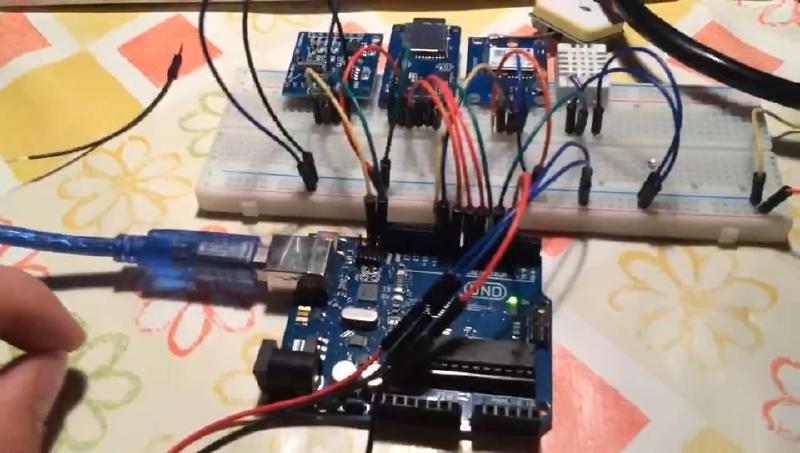
The smartwatch was designed around an Arduino Uno, which acted as the main controller. The system included:
- a Real-Time Clock (RTC) to keep time when the device was powered off
- a DHT22 sensor to measure temperature and humidity
- a GPS module to record position
- a display to show time, sensor data, and system status
- an SD card reader to store all collected data
I designed the PCB myself using Fritzing, learning how to connect components, route signals, and think about hardware layout.
 Components used in the project.
Firmware and Data Logging
All the firmware was written by me. The device continuously collected data from the sensors and GPS, displayed it on the screen, and stored it on the SD card.
The idea was to later use this data to reconstruct routes and locations, for example by plotting GPS points on a map and analyzing where I had been.
Although the final PCB was never manufactured, the system was programmed and tested at a functional level.
Why This Project Matters
Rejack was not a finished product, but it was a starting point.
It was my first contact with:
- embedded systems
- PCB design
- sensors and data logging
- combining hardware and software
Most importantly, it showed me that I could build complex systems by myself. This project directly motivated my next one — the DIY 3D printer — and from there I continued building more and more projects.
Final Notes
Rejack represents the moment when electronics and programming stopped being isolated experiments and became real projects for me. Even without being completed, it laid the foundations for everything I built later.